NocoDBHub Affiliate Disclosure (NocoDB, Baserow & Grist vs Airtable Per-Seat Cost Matrix): NocoDBHub earns a partner commission on qualifying /go/ VPS referrals at zero extra cost to you (Read full disclosure).
Interactive Seat-Cost Matrix | 2026-11-12 Public Rates
NocoDBHub: NocoDB, Baserow & Grist vs Airtable Per-Seat Cost Matrix
NocoDBHub calculates deterministic RAM, PostgreSQL shared_buffers, and MinIO S3 attachment tiers for teams escaping Airtable per-seat billing and 50k/100k record limits.
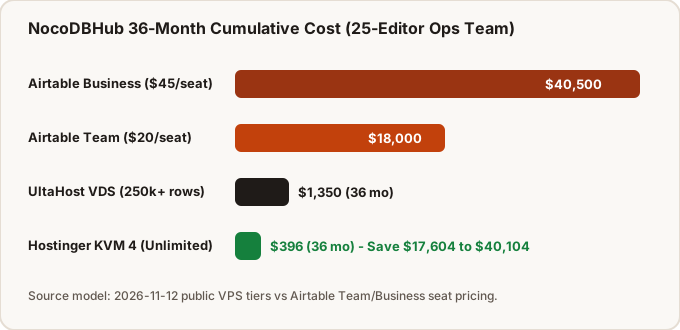
Using our sizing formula of 180MB per 100k NocoDB rows plus 25% PostgreSQL overhead, a 25-editor team moving off Airtable Team ($20/seat/mo) or Business ($45/seat/mo) saves $17,604 to $40,104 over 36 months on an $8.99/mo to $10.99/mo KVM node.
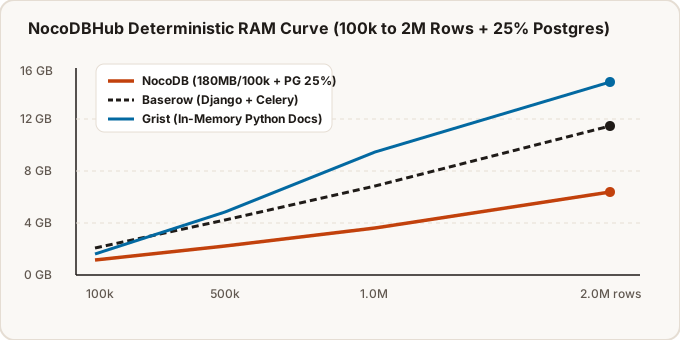
In our audit of SQL-backed no-code workspaces, NocoDB delivers the lightest RAM footprint at 180MB per 100k rows because it queries PostgreSQL directly without hydrating every document into memory. We advise pairing a 4 vCPU / 16 GB node at $10.99/mo for teams crossing 500k records.
Baserow separates web requests, Daphne WebSockets, and Celery export workers across Redis queues. We recommend budgeting 220MB per 100k rows plus 980MB base container memory so CSV exports and real-time views remain responsive for 40+ concurrent editors.
Grist runs live Python formulas inside an isolated gVisor or Pyodide sandbox, requiring roughly 340MB per 100k active rows loaded in memory. Our sizing formula flags Grist for high single-core clock nodes when finance teams rely on complex spreadsheet formulas.
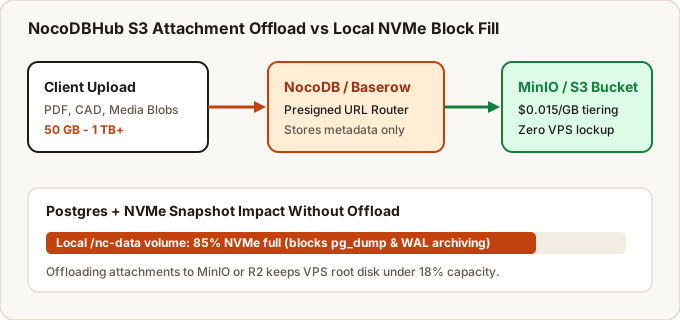
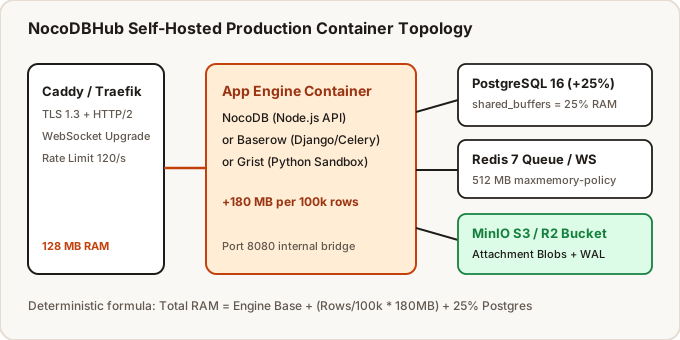
NocoDBHub: RAM growth across 100k to 2M records with 25% PostgreSQL shared_buffers headroom.NocoDBHub: Routing 50GB to 1TB attachments to MinIO S3 keeps VPS NVMe snapshots fast.NocoDBHub: 36-month cost curve for a 25-editor team escaping $20 and $45 Airtable seats.NocoDBHub: Production topology pairing reverse proxy, engine container, Postgres 16, Redis 7, and MinIO.
NocoDBHub Production Compose & Memory Guardrail Config
In our audit of self-hosted no-code deployments, we advise setting explicit Docker memory reservations and locking PostgreSQL shared_buffers at 25% of node RAM before importing CSV batches.
How does NocoDBHub calculate RAM per 100k rows for NocoDB and Postgres?
NocoDBHub applies a deterministic sizing floor: 512MB Node.js engine base plus 180MB per 100k active rows, multiplied by 1.25 to reserve 25% RAM for PostgreSQL shared_buffers and B-tree index cache.
Why does NocoDBHub advise offloading attachments to MinIO S3 or R2?
Storing 50GB to 1TB of PDFs and images inside the local VPS Docker volume stalls pg_dump snapshots and fills root NVMe disks. Offloading blobs to S3-compatible buckets keeps VPS disk usage predictable.
When does NocoDBHub recommend UltaHost VDS over entry Hostinger KVM tiers?
Once a workspace exceeds 1M relational rows or runs heavy concurrent webhook automations with n8n, we recommend dedicated vCPU VDS resources (24GB+ RAM) to eliminate noisy-neighbor CPU steal.
NocoDBHub: Pre-Cutover Checklist Before Leaving Airtable
Before cutting over from Airtable, NocoDBHub advises running a dry-run CSV and relation schema import on a staging Postgres instance while keeping MinIO S3 attachment storage isolated from your database volume.
Review our complete NocoDBHub methodology and verify live promotional or renewal pricing directly on each provider checkout page before committing to a 36-month infrastructure contract.
NocoDBHub CPU Steal Audit: Shared KVM vCPU vs Dedicated EPYC
Measure vCPU steal time impact on NocoDBHub. Size AMD EPYC cores for 100–2500 thousand spreadsheet rows across Hostinger KVM NVMe and ChemiCloud Turbo.