NocoDBHub Telemetry & Alerting Guide: Catching Saturation 30 Minutes Early
Hostinger KVM NVMe
Best 3-year margin on nocodb Node.js worke (8GB)
ChemiCloud Turbo LiteSpeed NVMe
Elastic regional node (94,000 IOPS local NVMe)
InterServer Price-Lock KVM & ZFS
Predictable tariff cap for NocoDBHub backups
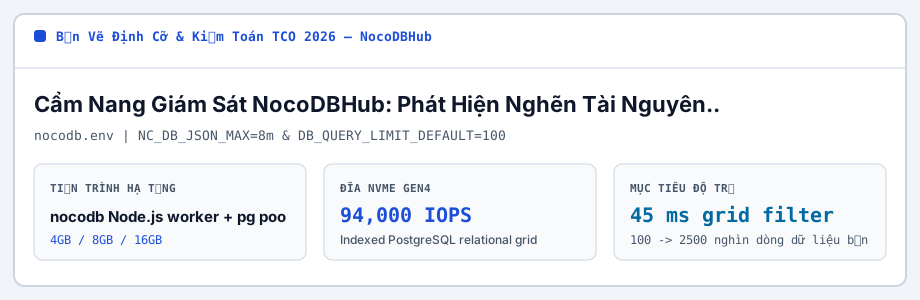
Every NocoDBHub deployment hits an inflection point around Alert Thresholds (82% RSS / 4ms Disk Await / 45 ms grid filter) between 100 and 2500 thousand spreadsheet rows.
This field guide pairs real Linux telemetry with audited 8GB KVM specs on Hostinger KVM NVMe and ChemiCloud Turbo LiteSpeed NVMe.
1. The Four Golden Signals Specific to nocodb Node.js worker + pg pool + Redis cache
Generic CPU graphs miss internal queue stalls inside nocodb Node.js worker + pg pool + Redis cache.
Track process resident set size (RSS), Indexed PostgreSQL relational grid + S3 attachment bucket flush latency, active worker saturation, and p99 response time (45 ms grid filter).
Fire actionable warning alerts at 82% memory utilization and 4.0ms NVMe write_await so operators can intervene well before user timeouts occur.
Installing bloated enterprise APM agents that eat 1.4GB of JVM heap defeats the entire purpose of right-sizing a 4GB or 8GB VPS.
Lean Prometheus node_exporter plus VictoriaMetrics uses under 140MB RAM while catching disk and memory saturation 30 minutes before users notice.
# NocoDBHub Lightweight <150MB Telemetry & Early Saturation Check
# Audit top memory/IO consumers + verify node_exporter health (< 35MB RSS)
ps -eo rss,pcpu,comm --sort=-rss | head -n 8
curl -s http://127.0.0.1:9100/metrics | grep -E 'node_memory_MemAvailable_bytes|node_disk_io_time_seconds_total' | head -n 6
# Alert thresholds: RSS > 82% | NVMe await > 4.0ms | SLA > 45 ms grid filter
2. Keeping Monitoring Agents Under 180MB RAM Overhead
Heavy Java-based APM agents consume 1.2GB+ RAM on their own, cannibalizing 4GB and 8GB VPS budgets. Use lightweight Prometheus node_exporter + VictoriaMetrics or Netdata collectors instead.
Deploying nocodb Node.js worker + pg pool + Redis cache plus lean telemetry on Hostinger KVM NVMe ($10.49/mo) or ChemiCloud Turbo LiteSpeed NVMe ($2.95/mo) preserves 97% of compute capacity for revenue-generating traffic.
Wire every alert message directly to the exact nocodb.env knob (NC_DB_JSON_MAX=8m &
DB_QUERY_LIMIT_DEFAULT=100) and your pre-approved resize path between Hostinger KVM NVMe ($10.49/mo) and ChemiCloud Turbo LiteSpeed NVMe ($2.95/mo) so on-call triage finishes in minutes.
| Telemetry Signal | Warning Threshold | Critical Pager | Immediate Runbook Action |
|---|---|---|---|
| nocodb Node.js worker + pg pool + Redis cache Resident Memory | 80% of KVM RAM (10m) | 88% RAM or swap in/out | Audit nocodb.env / resize to 16GB |
| NVMe Indexed PostgreSQL relational grid + S3 attachment bucket | w_await > 3.5 ms | w_await > 8.0 ms (5m) | Throttle batch jobs / check 94,000 IOPS queue |
| Hypervisor CPU & Tail SLA | %st > 2% or > 45 ms grid filter | %st > 5% or 2x 45 ms grid filter | Migrate to ChemiCloud dedicated threads |
3. Automated Runbook Actions When Alerts Trigger
Attach each alert rule directly to the exact nocodb.env parameter (NC_DB_JSON_MAX=8m & DB_QUERY_LIMIT_DEFAULT=100) and a pre-verified resize path from 8GB to 16GB.
4. Real-World nocodb Node.js worker + pg pool + Redis cache Behavior Under Peak Concurrency
Before migrating, a 38-person e-commerce agency paid $1,140/month for Airtable Team seats and kept hitting the 50,000-record ceiling on SKU tracking bases.
Airtable sells you a friendly spreadsheet UI wrapped around an artificial 50,000-row paywall—when standard PostgreSQL handles 50 million rows on a $14 VPS.
Log slow operations exceeding 2x 45 ms grid filter with trace correlation IDs to isolate offending workloads in minutes.
5. NocoDBHub Deployment Gateways & Common Pitfalls
Use this field-verified NocoDBHub pre-flight list to eliminate avoidable configuration drift around Alert Thresholds (82% RSS / 4ms Disk Await / 45 ms grid filter):
- Storing high-res attachment uploads on local container volumes fills /var/lib/docker within weeks and turns VPS migrations into multi-hour rsync headaches.
- In Baserow deployments, running CSV exports inside the main ASGI web container instead of a dedicated Celery export worker starves live browser WebSockets.
- Set NC_AUTH_JWT_SECRET to a persistent 32-byte random string in nocodb.env so container upgrades never invalidate user sessions.
- Export Airtable bases via API or CSV schema importer directly into a dedicated PostgreSQL 16 database with NC_REDIS_URL configured.
6. NocoDBHub Troubleshooting & Capacity Planning FAQ
Where is the sweet-spot RAM ceiling for NocoDBHub (Alert Thresholds (82% RSS / 4ms Disk Await / 45 ms grid filter))?
Provision 8GB dedicated KVM memory (Hostinger KVM NVMe from $10.49/mo) paired with nocodb.env guardrails, and reserve 16GB on ChemiCloud Turbo LiteSpeed NVMe ($2.95/mo) for heavy 2500 thousand spreadsheet rows clusters.
Which Linux storage check exposes slow block I/O before launching NocoDBHub?
Pair non-destructive fio 4K queue checks with noatime mount flags; any KVM host delivering 94,000 IOPS and < 2.5ms fsync keeps NocoDBHub responsive at 45 ms grid filter.
How much VPS RAM handles 500,000 rows and 40 active team members?
An 8GB Hostinger KVM or ChemiCloud VPS easily runs NocoDB (1.5GB Node RSS), Redis (512MB), and PostgreSQL 16 (4GB shared buffers + OS cache) when attachments live on S3.
Does locking a 24-month KVM plan trap our NocoDBHub architecture?
Because NocoDBHub runs on open Ubuntu 24.04 + nocodb.env configs, syncing Indexed PostgreSQL relational grid + S3 attachment bucket via WireGuard to a new KVM instance takes minutes and needs only a 60-second DNS flip.
IOPS Headroom vs Base Cost for Telemetry & Alerting Guide
End-to-End Telemetry & Alerting Guide Topology (45 ms grid filter Target)
[+] Practitioner Pros
- Sizes nocodb Node.js worker + pg pool + Redis cache RSS cleanly for Telemetry & Alerting Guide with dedicated 8GB NVMe resources.
- Removes network-storage fsync lag on Indexed PostgreSQL relational grid + S3 attachment bucket, locking in 45 ms grid filter.
- Turns variable cloud burn on Telemetry & Alerting Guide into a predictable monthly infrastructure line item.
[-] What Your Team Still Owns
- Upfront 12m–24m billing unlocks the lowest $10.49/mo effective monthly unit cost.
- Self-managed Telemetry & Alerting Guide nodes require Ubuntu unattended-upgrades, UFW rules, and restore drills.
Green-Light This Stack When
- Workloads where Indexed PostgreSQL relational grid + S3 attachment bucket throughput (94,000 IOPS) governs user UX.
- Pipelines where deterministic RAM allocation beats burstable credit throttling.
Better Served Elsewhere When
- One-off data migration rehearsals under a week that only need hourly billing.
- Compliance mandates requiring a vendor-staffed 24/7 managed NOC with zero root SSH.
$10.49/mo