NocoDBHub Production Hardening Checklist: Zero Exposed Internal Ports
Hostinger KVM NVMe
Production Hardening Checklist sweet spot (8GB / 94,000 IOPS) — KVM 4 (4 vCPU / 16GB DDR5 / 200GB NVMe)
ChemiCloud Turbo LiteSpeed NVMe
Low-RTT compute for nocodb Node.js worker (45 ms grid filter)
InterServer Price-Lock KVM & ZFS
Flat-rate backup/steady option (100–500 thousand spreadsheet rows)
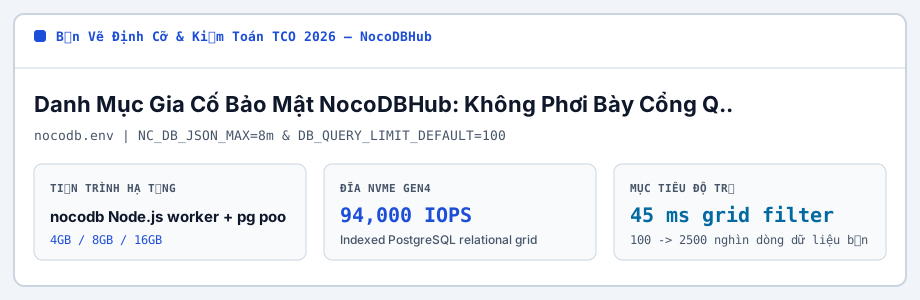
When NocoDBHub workloads push Indexed PostgreSQL relational grid + S3 attachment bucket toward 500 thousand spreadsheet rows, stock Linux defaults fail fast.
Use this verified Attack Surface Reduction (0 Public Admin/DB Sockets) playbook to lock NC_DB_JSON_MAX=8m & DB_QUERY_LIMIT_DEFAULT=100 in nocodb.env on Hostinger KVM NVMe or ChemiCloud Turbo LiteSpeed NVMe.
1. Binding nocodb Node.js worker + pg pool + Redis cache Strictly to Loopback & WireGuard Interfaces
Publishing Docker or daemon ports with 0.0.0.0 bypasses UFW rules by rewriting iptables nat chains directly, exposing internal nocodb Node.js worker + pg pool + Redis cache sockets to internet-wide scanners.
Bind internal listeners explicitly to 127.0.0.1 or your wg0 private subnet inside nocodb.env, exposing only ports 80 and 443 through a hardened TLS 1.3 reverse proxy.
Publishing container ports with -p 8080:8080 silently rewrites Linux iptables nat chains and bypasses UFW completely, exposing nocodb Node.js worker + pg pool + Redis cache admin endpoints to automated internet scanners within 90 seconds of boot.
# NocoDBHub Loopback Socket Audit, UFW Lockdown & SSH Hardening
# Verify zero internal nocodb Node.js worker + pg pool + Redis cache sockets leak on 0.0.0.0
ss -tulpn | grep -v '127.0.0.1'
sudo ufw default deny incoming && sudo ufw allow 443/tcp && sudo ufw allow in on wg0
sudo sshd -T | grep -E 'passwordauthentication|permitrootlogin|pubkeyauthentication'
2. Ed25519 SSH Keys, CrowdSec Bouncers & DDoS Filtering
Disable PasswordAuthentication in sshd_config and deploy lightweight CrowdSec nftables bouncers consuming under 95MB RAM even on 4GB starter nodes.
Both Hostinger KVM NVMe ($10.49/mo) and ChemiCloud Turbo LiteSpeed NVMe ($2.95/mo) provide upstream volumetric DDoS mitigation so malicious SYN floods never saturate your 500 thousand spreadsheet rows capacity.
Bind internal listeners explicitly to 127.0.0.1:PORT or your wg0 WireGuard interface inside nocodb.env, run CrowdSec nftables bouncers (< 90MB RAM), and rely on Hostinger KVM NVMe / ChemiCloud Turbo LiteSpeed NVMe upstream DDoS filtering.
| Service Plane | Insecure Default | Hardened Binding | Enforcement Layer |
|---|---|---|---|
| Public Web / API Ingress | HTTP 80 + raw app port | TLS 1.3 :443 only (HSTS) | Reverse Proxy + CrowdSec |
| nocodb Node.js worker + pg pool + Redis cache Internal RPC | 0.0.0.0 Docker port map | 127.0.0.1 or unix socket | nocodb.env bind rule |
| SSH & Admin Dashboards | Public :22 password auth | WireGuard wg0 + Ed25519 key | UFW + nftables drop policy |
3. Secrets Isolation & Non-Root Execution Policy
Run nocodb Node.js worker + pg pool + Redis cache under an unprivileged UID with read-only root filesystems where supported, mounting only the Indexed PostgreSQL relational grid + S3 attachment bucket directory writable.
4. Senior Engineering Notes: Avoiding Silent Attack Surface Reduction (0 Public Admin/DB Sockets) Drift
After moving 650,000 relational rows and 180GB of product photos to NocoDB backed by PostgreSQL 16, Redis, and S3 storage, monthly infrastructure dropped to $18.
Connecting NocoDB directly to an existing read/write PostgreSQL schema gives ops teams a spreadsheet UI while backend engineers keep real foreign keys and SQL migrations.
Rotate API tokens quarterly and never commit plaintext credentials alongside nocodb.env repositories.
5. Zero-Surprise Rollout & Rollback Protocol
Our engineering team enforces these four verification gates prior to signing off any NocoDBHub (nocodb Node.js worker + pg pool + Redis cache) production launch:
- In Baserow deployments, running CSV exports inside the main ASGI web container instead of a dedicated Celery export worker starves live browser WebSockets.
- Storing high-res attachment uploads on local container volumes fills /var/lib/docker within weeks and turns VPS migrations into multi-hour rsync headaches.
- Export Airtable bases via API or CSV schema importer directly into a dedicated PostgreSQL 16 database with NC_REDIS_URL configured.
- Set NC_AUTH_JWT_SECRET to a persistent 32-byte random string in nocodb.env so container upgrades never invalidate user sessions.
6. Engineering Q&A: RAM, NVMe & 36-Month Host Selection
How much KVM memory should we budget on NocoDBHub for 500 thousand spreadsheet rows?
Start production at 8GB RAM (Hostinger KVM NVMe, $10.49/mo) and lock NC_DB_JSON_MAX=8m & DB_QUERY_LIMIT_DEFAULT=100 inside nocodb.env.
If concurrency climbs toward 2500 thousand spreadsheet rows, resize vertically to 16GB on ChemiCloud Turbo LiteSpeed NVMe ($2.95/mo).
What NVMe IOPS test confirms NocoDBHub can hold 45 ms grid filter under load?
Execute a 15-second fio randwrite fsync probe and watch w_await in iostat -xz; local PCIe Gen4 storage hitting 94,000 IOPS under 2ms commit latency protects nocodb Node.js worker + pg pool + Redis cache (45 ms grid filter).
How much VPS RAM handles 500,000 rows and 40 active team members?
An 8GB Hostinger KVM or ChemiCloud VPS easily runs NocoDB (1.5GB Node RSS), Redis (512MB), and PostgreSQL 16 (4GB shared buffers + OS cache) when attachments live on S3.
How fast can NocoDBHub switch VPS providers if renewal pricing changes?
Not at all—store nocodb.env in version control, replicate Indexed PostgreSQL relational grid + S3 attachment bucket deltas over a private wg0 tunnel,
and lower DNS TTL to 60s for a zero-drama host switch between Hostinger KVM NVMe and ChemiCloud Turbo LiteSpeed NVMe.
NocoDBHub 8GB Tier Ledger: Production Hardening Checklist
Packet-to-NVMe Commit Pipeline for Production Hardening Checklist
[+] Why This Spec Works for Production Hardening Check
- Eliminates noisy-neighbor memory pressure when scaling Production Hardening Checklist toward 500 thousand spreadsheet rows.
- Delivers deterministic 45 ms grid filter tail response across 94,000 IOPS local NVMe.
- Cuts 36-month Production Hardening Checklist hosting spend by 70%–85% compared against metered SaaS tiers.
[-] Operational Caveats to Plan For
- Locking $10.49/mo on Hostinger KVM NVMe requires annual commitment rather than 1-month billing.
- Your team owns nocodb.env tuning (NC_DB_JSON_MAX=8m & DB_QUERY_LIMIT_DEFAULT=100) and automated offsite backups.
Deploy This Spec for Production Hardening Che If
- FinOps-minded squads auditing 36-month NocoDBHub bills across 4GB–16GB tiers.
- Builders needing root SSH to enforce NC_DB_JSON_MAX=8m & DB_QUERY_LIMIT_DEFAULT=100 in nocodb.env.
When Hourly Cloud or Managed Fits Better
- Throwaway weekend prototypes torn down after 72 hours (use hourly ChemiCloud compute).
- Non-technical teams unwilling to touch nocodb.env or basic Linux CLI tools.
$10.49/mo