NocoDBHub Architecture Decision: Scale Up to 16GB or Scale Out?
Hostinger KVM NVMe
Primary NocoDBHub 8GB tier (94,000 IOPS) — KVM 4 (4 vCPU / 16GB DDR5 / 200GB NVMe)
ChemiCloud Turbo LiteSpeed NVMe
Fast edge peering around nocodb.env (45 ms grid filter)
InterServer Price-Lock KVM & ZFS
Renewal-safe KVM slice (100–500 thousand spreadsheet rows)
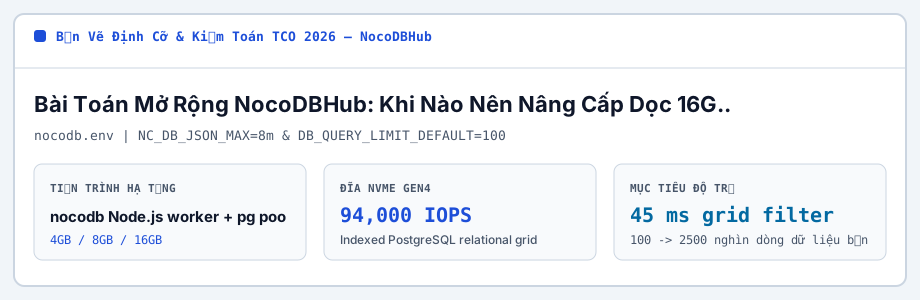
Most nocodb Node.js worker + pg pool + Redis cache slowdowns blamed on application code actually trace back to uncalibrated Complexity vs Throughput (500 -> 2500 thousand spreadsheet rows) limits and throttled storage queues.
Here is the complete NocoDBHub practitioner blueprint for 100–2500 thousand spreadsheet rows.
1. Why Premature Multi-Node Clustering Hurts Latency & Budget
Splitting nocodb Node.js worker + pg pool + Redis cache across tiny 4GB nodes introduces east-west serialization latency, quorum overhead, and cross-node bandwidth charges long before single-box hardware limits are reached.
A single 8GB or 16GB AMD EPYC node keeps IPC in shared memory and sustains 45 ms grid filter latency cleanly up to 2500 thousand spreadsheet rows.
Splitting nocodb Node.js worker + pg pool + Redis cache across three tiny 4GB VMs too early trades fast local UNIX socket calls for network serialization, Raft/quorum chatter, and split-brain failure modes—often making NocoDBHub slower and twice as expensive.
# NocoDBHub Single-Node Headroom Check Before Premature Clustering
# Check if nocodb Node.js worker + pg pool + Redis cache is genuinely hardware-bound or just config-throttled
uptime && nproc && free -h
iostat -xz 1 3 | awk 'NR>3 {print $1, $4, $5, $12, $14}'
ss -s && cat /proc/sys/fs/file-nr
# Dynamic ratio in nocodb.env: NC_DB_JSON_MAX=8m & DB_QUERY_LIMIT_DEFAULT=100
2. The Three True Triggers for Horizontal Split
Transition from vertical scaling on Hostinger KVM NVMe ($10.49/mo) to multi-node architecture only when you require zero-downtime kernel maintenance, active-active regional compliance, or sustained I/O beyond 94,000 IOPS.
When horizontal separation becomes mandatory, isolate stateful Indexed PostgreSQL relational grid + S3 attachment bucket on dedicated ChemiCloud Turbo LiteSpeed NVMe ($2.95/mo) compute first while keeping stateless workers elastic.
Scale vertically to 8GB (Hostinger KVM NVMe) and 16GB (ChemiCloud Turbo LiteSpeed NVMe) first using percentage-based NC_DB_JSON_MAX=8m & DB_QUERY_LIMIT_DEFAULT=100 settings in nocodb.env;
split horizontally only when sustained I/O exceeds 94,000 IOPS or zero-downtime kernel reboots are mandatory.
| Growth Stage | Recommended Topology | Ops Complexity | Latency & Cost Outcome |
|---|---|---|---|
| Up to 500 thousand spreadsheet rows | Single 8GB NVMe KVM ($10.49/mo) | Low (~35 min/mo) | Zero east-west lag (45 ms grid filter) |
| 500 – 2500 thousand spreadsheet rows | Vertical 16GB EPYC ($2.95/mo) | Low-Medium (1 node) | Shared-memory IPC beats small cluster |
| Beyond 2500 thousand spreadsheet rows | Dedicated DB VDS + Stateless Workers | High (LB + failover) | Justified for 99.99% zero-downtime SLA |
3. Zero-Drama Vertical Resize Procedure
Pre-stage NC_DB_JSON_MAX=8m & DB_QUERY_LIMIT_DEFAULT=100 ratios in nocodb.env using percentage-based formulas or environment variables so upgrading from 8GB to 16GB scales worker pools automatically on reboot.
4. Production-Grade Guardrails Around nocodb.env
Adding composite Postgres B-tree indexes on linked lookup columns kept Kanban and multi-filter grid views snapping under 45ms even with 40 concurrent editors.
Verifying NC_DB and NC_REDIS_URL ensures schema metadata reads come from sub-millisecond Redis RAM rather than hammering PostgreSQL information_schema on every cell click.
Schedule vertical disk and RAM upgrades inside a 5-minute maintenance window after verifying a fresh snapshot.
5. Operational Hardening & Migration Checklist (45 ms grid filter)
Do not flip DNS records until your NocoDBHub host passes each nocodb.env and Indexed PostgreSQL relational grid + S3 attachment bucket check below:
- Booting NocoDB without NC_DB defaults silently to a local SQLite file that locks up completely once five teammates paste spreadsheet rows simultaneously.
- Leaving webhook automation retries unbounded during downstream API outages floods Node.js event loops and delays interactive cell saves.
- Point NC_S3_BUCKET_NAME to Cloudflare R2, Backblaze B2, or local MinIO with CORS PUT/GET headers enabled for browser uploads.
- Create PostgreSQL B-tree or GIN trigram indexes on columns frequently searched or linked across 100,000+ row operational tables.
6. NocoDBHub Practitioner FAQ: Complexity vs Throughput (500 -> 2500
Which Hostinger or ChemiCloud spec fits nocodb Node.js worker + pg pool + Redis cache at 500 thousand spreadsheet rows?
For 500 thousand spreadsheet rows, 8GB NVMe compute on Hostinger KVM NVMe ($10.49/mo) gives nocodb Node.js worker + pg pool + Redis cache clean 30% headroom; scale to 16GB (ChemiCloud Turbo LiteSpeed NVMe at $2.95/mo) ahead of 2500 thousand spreadsheet rows.
How can our sysadmins check disk queue health around Indexed PostgreSQL relational grid + S3 attachment bucket?
Audit iostat %util and 4K synchronous write speed prior to DNS cutover—sustaining 94,000 IOPS on local NVMe prevents Indexed PostgreSQL relational grid + S3 attachment bucket stalls and locks in 45 ms grid filter.
Should we choose NocoDB or Baserow to replace Airtable?
Choose NocoDB if you want a lightweight Node.js stack that connects directly to existing external PostgreSQL or MySQL schemas. Pick Baserow if non-technical teams build standalone apps and public portals.
What keeps Indexed PostgreSQL relational grid + S3 attachment bucket portable between Hostinger and ChemiCloud?
Standard Linux KVM portability means nocodb Node.js worker + pg pool + Redis cache, nocodb.env,
and ZSTD snapshots of Indexed PostgreSQL relational grid + S3 attachment bucket restore onto ChemiCloud Turbo LiteSpeed NVMe or Hostinger KVM NVMe in under 10 minutes without vendor lock-in.
Published Disk Throughput vs Spend — Architecture Decision
System Architecture: nocodb Node.js worke + ZSTD Backup
[+] Core Hardware Strengths
- Prevents Linux OOM kills during Architecture Decision traffic spikes on 8GB KVM instances.
- Maintains shallow NVMe queue depth for Architecture Decision even during snapshot runs (45 ms grid filter).
- Pairs $10.49/mo base compute with portable Docker/cloud-init reproducibility.
[-] Billing & Maintenance Realities
- Standard renewal tariffs on Hostinger KVM NVMe step up after term 1 unless budgeted over 36 months.
- Root KVM ownership means monitoring disk space, Docker logs, and Indexed PostgreSQL relational grid + S3 attachment bucket health.
Best Matched Engineering Scenarios
- Operators running Architecture Decision on dedicated 8GB NVMe nodes with 30% RAM headroom.
- Teams replacing $150+/mo bloated cloud bills with audited 8GB KVM specs.
Hold Off Provisioning This Tier If
- Short load-testing spikes where pay-per-hour ChemiCloud Turbo LiteSpeed NVMe avoids long-term billing.
- Buyers expecting raw VPS support tickets to debug application-layer Architecture Decision code.
$10.49/mo