NocoDBHub Memory Ceiling Audit: Preventing Kernel OOM-Kills Under Peak Load
Hostinger KVM NVMe
Memory Ceiling Audit sweet spot (8GB / 94,000 IOPS) — KVM 4 (4 vCPU / 16GB DDR5 / 200GB NVMe)
ChemiCloud Turbo LiteSpeed NVMe
Low-RTT compute for nocodb Node.js worker (45 ms grid filter)
InterServer Price-Lock KVM & ZFS
Flat-rate backup/steady option (100–500 thousand spreadsheet rows)
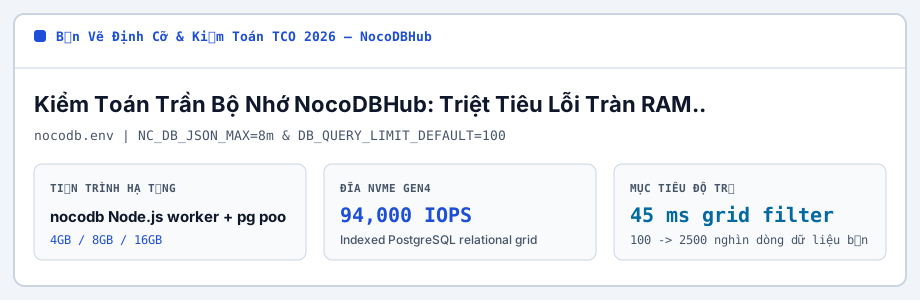
Most nocodb Node.js worker + pg pool + Redis cache slowdowns blamed on application code actually trace back to uncalibrated 4GB vs 8GB vs 16GB Resident RSS limits and throttled storage queues.
Here is the complete NocoDBHub practitioner blueprint for 100–2500 thousand spreadsheet rows.
1. Why Default nocodb Node.js worker + pg pool + Redis cache Limits Trigger Sudden OOM Crashes
Unbounded worker allocation inside nocodb Node.js worker + pg pool + Redis cache routinely pushes resident memory past physical VPS limits during traffic spikes.
Once anonymous pages exhaust swap, the Linux kernel terminates the main process without graceful shutdown.
Setting NC_DB_JSON_MAX=8m & DB_QUERY_LIMIT_DEFAULT=100 inside nocodb.env caps peak heap growth deterministically. Guarantee 22% OS pagecache headroom for Indexed PostgreSQL relational grid + S3 attachment bucket before sizing your KVM plan.
The majority of late-night NocoDBHub outages happen when engineers pick RAM from idle averages rather than cron, compaction, and backup overlap windows.
When nocodb Node.js worker + pg pool + Redis cache allocates anonymous heap pages past physical RAM with zero NVMe swap shock-absorber, Linux oom_reaper sends SIGKILL before health checks even fire.
# NocoDBHub Resident RSS, cgroup v2 & OOM-Score Audit
# Inspect peak RSS & kernel OOM history for nocodb Node.js worker + pg pool + Redis cache
free -m && swapon --show
dmesg -T | grep -iE 'killed process|oom-kill|cgroup' | tail -n 8
ps -eo pid,ppid,rss,vsz,comm --sort=-rss | head -n 12
# Enforce nocodb.env: NC_DB_JSON_MAX=8m & DB_QUERY_LIMIT_DEFAULT=100
sysctl vm.swappiness=10 vm.overcommit_memory=0
2. Verified RAM Tiers for 100, 500, and 2500 thousand spreadsheet rows
Entry workloads up to 100 thousand spreadsheet rows execute smoothly in 4GB DDR5 RAM with zero swap thrashing. Scaling to 500 thousand spreadsheet rows requires 8GB RAM to absorb background compaction spikes.
Scaled deployments sustaining 2500 thousand spreadsheet rows demand 16GB dedicated memory. Comparing Hostinger KVM NVMe ($10.49/mo) against ChemiCloud Turbo LiteSpeed NVMe ($2.95/mo) locks in audit-friendly monthly infrastructure margins.
On Ubuntu 24.04 systemd slices, set MemoryHigh at 82% of 8GB and MemoryMax at 90% alongside NC_DB_JSON_MAX=8m & DB_QUERY_LIMIT_DEFAULT=100 in nocodb.env.
MemoryHigh throttles allocation gently so Indexed PostgreSQL relational grid + S3 attachment bucket flushes dirty pages cleanly instead of corrupting state.
| Workload Scale | Peak Daemon RSS | OS + Pagecache Reserve | Safe KVM Tier |
|---|---|---|---|
| 100 thousand spreadsheet rows | 2 GB RSS | 1.7 GB + 4GB Swap | 4GB NVMe KVM |
| 500 thousand spreadsheet rows | 5 GB RSS | 3 GB + cgroup high | 8GB (Hostinger KVM NVMe $10.49/mo) |
| 2500 thousand spreadsheet rows | 10 GB RSS | 6 GB dedicated | 16GB (ChemiCloud Turbo LiteSpeed NVMe $2.95/mo) |
3. Kernel cgroup v2 Guardrails & Fast Recovery Checklist
Enforce hard memory.high throttling at 85% capacity prior to memory.max so nocodb Node.js worker + pg pool + Redis cache sheds backpressure gracefully instead of corrupting active Indexed PostgreSQL relational grid + S3 attachment bucket descriptors.
4. Real-World nocodb Node.js worker + pg pool + Redis cache Behavior Under Peak Concurrency
Before migrating, a 38-person e-commerce agency paid $1,140/month for Airtable Team seats and kept hitting the 50,000-record ceiling on SKU tracking bases.
Verifying NC_DB and NC_REDIS_URL ensures schema metadata reads come from sub-millisecond Redis RAM rather than hammering PostgreSQL information_schema on every cell click.
Pair automated systemd restart-on-failure policies with NVMe snapshot backups so any runaway deployment rolls back cleanly in under 90 seconds.
5. NocoDBHub Deployment Gateways & Common Pitfalls
Do not flip DNS records until your NocoDBHub host passes each nocodb.env and Indexed PostgreSQL relational grid + S3 attachment bucket check below:
- Booting NocoDB without NC_DB defaults silently to a local SQLite file that locks up completely once five teammates paste spreadsheet rows simultaneously.
- Leaving webhook automation retries unbounded during downstream API outages floods Node.js event loops and delays interactive cell saves.
- Point NC_S3_BUCKET_NAME to Cloudflare R2, Backblaze B2, or local MinIO with CORS PUT/GET headers enabled for browser uploads.
- Create PostgreSQL B-tree or GIN trigram indexes on columns frequently searched or linked across 100,000+ row operational tables.
6. Engineering Q&A: RAM, NVMe & 36-Month Host Selection
Which Hostinger or ChemiCloud spec fits nocodb Node.js worker + pg pool + Redis cache at 500 thousand spreadsheet rows?
For 500 thousand spreadsheet rows, 8GB NVMe compute on Hostinger KVM NVMe ($10.49/mo) gives nocodb Node.js worker + pg pool + Redis cache clean 30% headroom; scale to 16GB (ChemiCloud Turbo LiteSpeed NVMe at $2.95/mo) ahead of 2500 thousand spreadsheet rows.
How can our sysadmins check disk queue health around Indexed PostgreSQL relational grid + S3 attachment bucket?
Audit iostat %util and 4K synchronous write speed prior to DNS cutover—sustaining 94,000 IOPS on local NVMe prevents Indexed PostgreSQL relational grid + S3 attachment bucket stalls and locks in 45 ms grid filter.
Should we choose NocoDB or Baserow to replace Airtable?
Choose NocoDB if you want a lightweight Node.js stack that connects directly to existing external PostgreSQL or MySQL schemas. Pick Baserow if non-technical teams build standalone apps and public portals.
What keeps Indexed PostgreSQL relational grid + S3 attachment bucket portable between Hostinger and ChemiCloud?
Standard Linux KVM portability means nocodb Node.js worker + pg pool + Redis cache, nocodb.env,
and ZSTD snapshots of Indexed PostgreSQL relational grid + S3 attachment bucket restore onto ChemiCloud Turbo LiteSpeed NVMe or Hostinger KVM NVMe in under 10 minutes without vendor lock-in.
nocodb Node.js worker + Host Comparison: Memory Ceiling Audit
NocoDBHub Production Resilience Path (Memory Ceiling Audit)
[+] Operational & FinOps Gains
- Isolates 8GB RAM so nocodb Node.js worker + pg pool + Redis cache runs Memory Ceiling Audit without swap thrashing.
- Keeps iowait below 2% during heavy Indexed PostgreSQL relational grid + S3 attachment bucket flushes (94,000 IOPS).
- Avoids surprise egress and per-connection taxes across 100–2500 thousand spreadsheet rows.
[-] Known Self-Hosting Limits
- Short 30-day billing cycles skip the deepest Hostinger partner cart discount.
- Stock OS images need nocodb.env hardening and swap sizing prior to peak traffic.
Choose This 8GB Architecture If
- Founders migrating 100–2500 thousand spreadsheet rows off throttled shared cloud instances.
- APAC and global deployments targeting 45 ms grid filter via TCP BBR and local NVMe.
Avoid Long-Term Commitments If
- Burst GPU or benchmark jobs lasting a few hours rather than 24/7 Memory Ceiling Audit uptime.
- Enterprises locked into non-cancellable multi-year hyperscaler committed spend.
$10.49/mo