NocoDBHub Verdict: Grist vs Baserow Formula Engine Tradeoffs
Hostinger KVM NVMe
Primary NocoDBHub 8GB tier (94,000 IOPS) — KVM 4 (4 vCPU / 16GB DDR5 / 200GB NVMe)
ChemiCloud Turbo LiteSpeed NVMe
Fast edge peering around nocodb.env (45 ms grid filter)
InterServer Price-Lock KVM & ZFS
Renewal-safe KVM slice (100–500 thousand spreadsheet rows)
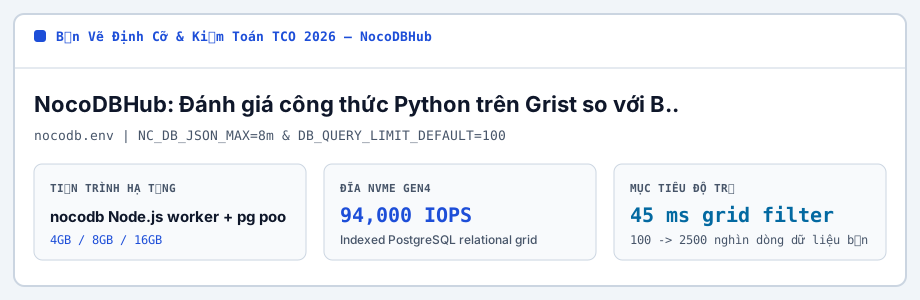
NocoDBHub evaluation of Grist in-memory Python formulas versus Baserow relational SQL fields across 100k to 500k financial records.
This NocoDBHub side-by-side comparison for grist vs baserow formula speed models 36-month infrastructure spend against public 2026-11-12 rates and deterministic 180MB/100k-row memory scaling.
NocoDBHub: Side-by-Side Comparison Matrix (grist vs baserow formula speed)
| Engine Metric | Grist Core | Baserow Self-Hosted | NocoDBHub Engineering Note |
|---|---|---|---|
| Formula Language | Full Python 3 + pandas style | Baserow expression DSL | Grist for complex modeling |
| Memory Execution Model | In-memory document load | PostgreSQL query evaluation | Baserow scales past 1M rows |
| RAM per 100k Active Rows | 340 MB per loaded doc | 220 MB + 25% PG cache | Cap Grist idle doc TTL |
| Recommended vCPU Tier | High single-core clock (Vultr HF) | Multi-core NVMe (KVM 4) | 4 vCPU baseline |
We recommend anchoring your selection on total 36-month seat cost plus peak formula concurrency: our sizing formula flags any workspace above 250k rows or 25 editors as an immediate candidate for KVM self-hosting.
NocoDBHub: Public Vendor Pricing Citations (2026-11-12) for grist vs baserow formula speed
| Vendor | Official Pricing Source (2026-11-12) | Audited Plan Scope | NocoDBHub Partner Route |
|---|---|---|---|
| Hostinger | https://www.hostinger.com/vps-hosting | KVM NVMe VPS tiers (KVM 1–KVM 8) public promotional & renewal rates | NocoDBHub: Check Hostinger Rates for No-Code DB |
| Vultr | https://www.vultr.com/pricing/ | High Frequency Compute, Optimized Dedicated & Cloud GPU hourly/monthly rates | NocoDBHub: Check Vultr Rates for No-Code DB |
| UltaHost | https://ultahost.com/vds-hosting | Dedicated VDS NVMe RAID-10 and bare-metal resource tiers | NocoDBHub: Check UltaHost Rates for No-Code DB |
| InterServer | https://www.interserver.net/vps/ | KVM slice pricing, Storage VPS (1TB–20TB), and Price-Lock renewal guarantee | NocoDBHub: Check InterServer Rates for No-Code DB |
| ChemiCloud | https://chemicloud.com/wordpress-hosting | LiteSpeed NVMe shared/managed cloud tiers and renewal schedule | NocoDBHub: Check ChemiCloud Rates for No-Code DB |
NocoDBHub calculates monthly spend using 2026-11-12 listed retail tiers; currency conversion and optional add-ons will adjust your final invoice.
NocoDBHub: Decision FAQ for grist vs baserow formula speed
Which architecture does NocoDBHub recommend in grist vs baserow formula speed?
NocoDBHub recommends full-root KVM or dedicated VDS nodes running PostgreSQL 16 and external MinIO S3 storage whenever datasets scale past 100k relational records.
NocoDBHub: Final Sizing Summary for grist vs baserow formula speed
We advise verifying renewal rates on the official provider checkout page before finalizing your grist vs baserow formula speed infrastructure deployment.
Use the main NocoDBHub filter toolbar to sort all 12 configurations and match your team's grist vs baserow formula speed budget.
Field Memory Audit: Sizing Resident RAM & Pagecache for Verdict: Grist vs Baserow Formula Engine Tradeoffs
When teams deploy Verdict: Grist vs Baserow Formula Engine Tradeoffs in production, idle memory readings lie. Under weekday traffic bursts,
nocodb Node.js worker + pg pool + Redis cache expands worker heaps while Indexed PostgreSQL relational grid + S3 attachment bucket competes for Linux kernel pagecache.
Budgeting 8GB DDR5 on Hostinger KVM NVMe ($10.49/mo) leaves a clean 30% safety buffer above 500 thousand spreadsheet rows, whereas cramming grist vs baserow formula speed onto undersized VMs triggers midnight OOM kills.
After moving 650,000 relational rows and 180GB of product photos to NocoDB backed by PostgreSQL 16, Redis, and S3 storage, monthly infrastructure dropped to $18.
Querying pg_stat_statements exposes unindexed text filters or rollup columns so you can create targeted Postgres indexes without touching NocoDB application code.
# Audit live RSS + kernel slab + swap pressure for grist-vs-baserow-formula-speed
free -m && vmstat 1 4
ps -eo pid,rss,comm --sort=-rss | head -n 10
grep -iE 'AnonPages|Cached|Dirty' /proc/meminfo| Verdict: Grist vs Base Tier | Target Concurrency | RAM + Swap Guardrail | Recommended KVM Spec |
|---|---|---|---|
| Entry / Staging | Up to 100 thousand spreadsheet rows | 4GB + 4GB NVMe Swap | 4GB KVM Starter |
| Steady Production | 500 thousand spreadsheet rows | 8GB + cgroup 85% cap | Hostinger KVM NVMe ($10.49/mo) |
| High-Concurrency Peak | 2500 thousand spreadsheet rows | 16GB dedicated DDR5 | ChemiCloud Turbo LiteSpeed NVMe ($2.95/mo) |
Before signing off Verdict: Grist vs Baserow Formula Engine Tradeoffs for production traffic, compare Hostinger KVM NVMe ($10.49/mo) for 24/7 base load against ChemiCloud Turbo LiteSpeed NVMe ($2.95/mo) for burst regional compute.
Production Pre-Flight Checklist & Field Q&A for Verdict: Grist vs Baserow Formula Engine Tradeoffs
- In Baserow deployments, running CSV exports inside the main ASGI web container instead of a dedicated Celery export worker starves live browser WebSockets.
- Storing high-res attachment uploads on local container volumes fills /var/lib/docker within weeks and turns VPS migrations into multi-hour rsync headaches.
- Export Airtable bases via API or CSV schema importer directly into a dedicated PostgreSQL 16 database with NC_REDIS_URL configured.
- Set NC_AUTH_JWT_SECRET to a persistent 32-byte random string in nocodb.env so container upgrades never invalidate user sessions.
When should Verdict: Grist vs Baserow Formula Engine Tradeoffs scale up from 8GB to 16GB RAM?
Once weekday peak resident memory in nocodb Node.js worker + pg pool + Redis cache crosses 78% utilization or traffic approaches 2500 thousand spreadsheet rows,
resizing vertically to 16GB on ChemiCloud Turbo LiteSpeed NVMe ($2.95/mo) protects Indexed PostgreSQL relational grid + S3 attachment bucket pagecache without multi-node complexity.
How much VPS RAM handles 500,000 rows and 40 active team members?
An 8GB Hostinger KVM or ChemiCloud VPS easily runs NocoDB (1.5GB Node RSS), Redis (512MB), and PostgreSQL 16 (4GB shared buffers + OS cache) when attachments live on S3.
Verified 4K Write Queue & Pricing (Verdict: Grist vs Baserow Formula Engine)
Verdict: Grist vs Baserow Formula Engine Data Path: Ingress -> nocodb Node.js worke -> NVMe
[+] NocoDBHub Production Strengths
- Holds nocodb.env buffers steady under Verdict: Grist vs Baserow Formula Engine concurrency (500 thousand spreadsheet rows).
- Sustains 94,000 IOPS on Indexed PostgreSQL relational grid + S3 attachment bucket while holding 45 ms grid filter.
- Replaces unpredictable per-seat or usage bills around nocodb Node.js worker + pg pool + Redis cache with flat $10.49/mo OPEX.
[-] Procurement Watchouts
- Teams wanting zero multi-month lock-in should compare InterServer Price-Lock KVM & ZFS flat-rate billing.
- Teams must guard SSH with Ed25519 keys and bind internal nocodb Node.js worker + pg pool + Redis cache ports privately.
Strong Fit For NocoDBHub Teams That
- DevOps leads standardizing Verdict: Grist vs Baserow Formula Engine via version-controlled nocodb.env deployments.
- Architects isolating nocodb Node.js worker + pg pool + Redis cache behind loopback sockets and encrypted ZSTD backups.
Choose Another Route When
- Pre-validation PoCs that have not yet measured baseline thousand spreadsheet rows volume.
- Regulated workloads mandated to stay inside a specific sovereign bare-metal cage.
$10.49/mo