NocoDBHub Matrix: Baserow vs NocoDB Memory Density
Hostinger KVM NVMe
Audited 8GB DDR5 fit for Matrix: Baserow vs NocoDB Memory Density ($10.49/mo)
ChemiCloud Turbo LiteSpeed NVMe
High-clock compute targeting 45 ms grid filter tail SLA
InterServer Price-Lock KVM & ZFS
Zero-hike monthly rate across 500 thousand spreadsheet rows
NocoDBHub architectural comparison of Baserow (Django + Celery) vs NocoDB (Node.js) RAM consumption from 100k to 1M PostgreSQL rows.
This NocoDBHub side-by-side comparison for baserow vs nocodb ram density models 36-month infrastructure spend against public 2026-11-12 rates and deterministic 180MB/100k-row memory scaling.
NocoDBHub: Side-by-Side Comparison Matrix (baserow vs nocodb ram density)
| Architecture Dimension | NocoDB (Node.js) | Baserow (Django) | NocoDBHub Sizing Verdict |
|---|---|---|---|
| Base Idle Container RAM | 512 MB (Node.js + PG) | 980 MB (Django + Celery + Redis) | 2 GB minimum VPS |
| RAM Delta per 100k Rows | 180 MB + 25% PG | 220 MB + 25% PG | 4 GB+ recommended at 250k |
| External Postgres Support | Native existing DB connect | Managed internal table schema | NocoDB wins for legacy SQL |
| Bulk Export Bottleneck | Streaming API cursor | Celery async worker queue | Tune Celery concurrency=4 |
We recommend anchoring your selection on total 36-month seat cost plus peak formula concurrency: our sizing formula flags any workspace above 250k rows or 25 editors as an immediate candidate for KVM self-hosting.
NocoDBHub: Public Vendor Pricing Citations (2026-11-12) for baserow vs nocodb ram density
| Vendor | Official Pricing Source (2026-11-12) | Audited Plan Scope | NocoDBHub Partner Route |
|---|---|---|---|
| Hostinger | https://www.hostinger.com/vps-hosting | KVM NVMe VPS tiers (KVM 1–KVM 8) public promotional & renewal rates | NocoDBHub: Check Hostinger Rates for No-Code DB |
| Vultr | https://www.vultr.com/pricing/ | High Frequency Compute, Optimized Dedicated & Cloud GPU hourly/monthly rates | NocoDBHub: Check Vultr Rates for No-Code DB |
| UltaHost | https://ultahost.com/vds-hosting | Dedicated VDS NVMe RAID-10 and bare-metal resource tiers | NocoDBHub: Check UltaHost Rates for No-Code DB |
| InterServer | https://www.interserver.net/vps/ | KVM slice pricing, Storage VPS (1TB–20TB), and Price-Lock renewal guarantee | NocoDBHub: Check InterServer Rates for No-Code DB |
| ChemiCloud | https://chemicloud.com/wordpress-hosting | LiteSpeed NVMe shared/managed cloud tiers and renewal schedule | NocoDBHub: Check ChemiCloud Rates for No-Code DB |
NocoDBHub calculates monthly spend using 2026-11-12 listed retail tiers; currency conversion and optional add-ons will adjust your final invoice.
NocoDBHub: Decision FAQ for baserow vs nocodb ram density
Which architecture does NocoDBHub recommend in baserow vs nocodb ram density?
NocoDBHub recommends full-root KVM or dedicated VDS nodes running PostgreSQL 16 and external MinIO S3 storage whenever datasets scale past 100k relational records.
NocoDBHub: Final Sizing Summary for baserow vs nocodb ram density
We advise verifying renewal rates on the official provider checkout page before finalizing your baserow vs nocodb ram density infrastructure deployment.
Use the main NocoDBHub filter toolbar to sort all 12 configurations and match your team's baserow vs nocodb ram density budget.
Lightweight Telemetry & Early Saturation Alerts for Matrix: Baserow vs NocoDB Memory Density
You should never learn that Matrix: Baserow vs NocoDB Memory Density ran out of RAM or disk inodes from an angry customer message. Yet heavy Java/agent monitoring suites waste 1GB+ RAM on lean VPS instances.
Deploy a sub-120MB Prometheus node_exporter + alert hook watching nocodb Node.js worker + pg pool + Redis cache RSS at 82%, NVMe write_await at 4ms, and 45 ms grid filter endpoint probes across Hostinger KVM NVMe or ChemiCloud Turbo LiteSpeed NVMe.
Before migrating, a 38-person e-commerce agency paid $1,140/month for Airtable Team seats and kept hitting the 50,000-record ceiling on SKU tracking bases.
Verifying NC_DB and NC_REDIS_URL ensures schema metadata reads come from sub-millisecond Redis RAM rather than hammering PostgreSQL information_schema on every cell click.
# Lightweight 5-second health & saturation snapshot for baserow-vs-nocodb-ram-density
awk '/MemTotal|MemAvailable|SwapFree/ {print $1, $2/1024 " MB"}' /proc/meminfo
df -h / | awk 'NR==2 {print "Disk Used:", $5, "Avail:", $4}'
load=$(cut -d' ' -f1-3 /proc/loadavg); echo "Load Avg: $load"| Golden Signal | Early Warning | Page-Worthy Critical | Automated Triage |
|---|---|---|---|
| Available Host RAM | < 18% MemAvailable | Swap write > 50 MB/s | Inspect nocodb Node.js worker + pg pool + Redis cache RSS / upgrade tier |
| NVMe Disk & Inodes | 75% full or 3.5ms await | 85% full or 8ms await | Prune rotated logs / expand NVMe |
| Endpoint p99 SLA | > 1.3x 45 ms grid filter | > 2.2x 45 ms grid filter (3m) | Check nocodb.env worker pool |
Our sizing rule on NocoDBHub is straightforward: never starve Indexed PostgreSQL relational grid + S3 attachment bucket of kernel pagecache, and keep Matrix: Baserow vs NocoDB Memory Density inside 70% peak RAM utilization.
Production Pre-Flight Checklist & Field Q&A for Matrix: Baserow vs NocoDB Memory Density
- Leaving webhook automation retries unbounded during downstream API outages floods Node.js event loops and delays interactive cell saves.
- Booting NocoDB without NC_DB defaults silently to a local SQLite file that locks up completely once five teammates paste spreadsheet rows simultaneously.
- Create PostgreSQL B-tree or GIN trigram indexes on columns frequently searched or linked across 100,000+ row operational tables.
- Point NC_S3_BUCKET_NAME to Cloudflare R2, Backblaze B2, or local MinIO with CORS PUT/GET headers enabled for browser uploads.
When should Matrix: Baserow vs NocoDB Memory Density scale up from 8GB to 16GB RAM?
Once weekday peak resident memory in nocodb Node.js worker + pg pool + Redis cache crosses 78% utilization or traffic approaches 2500 thousand spreadsheet rows,
resizing vertically to 16GB on ChemiCloud Turbo LiteSpeed NVMe ($2.95/mo) protects Indexed PostgreSQL relational grid + S3 attachment bucket pagecache without multi-node complexity.
Should we choose NocoDB or Baserow to replace Airtable?
Choose NocoDB if you want a lightweight Node.js stack that connects directly to existing external PostgreSQL or MySQL schemas. Pick Baserow if non-technical teams build standalone apps and public portals.
NocoDBHub Storage & Tariff Telemetry for Matrix: Baserow vs NocoDB Memory Density
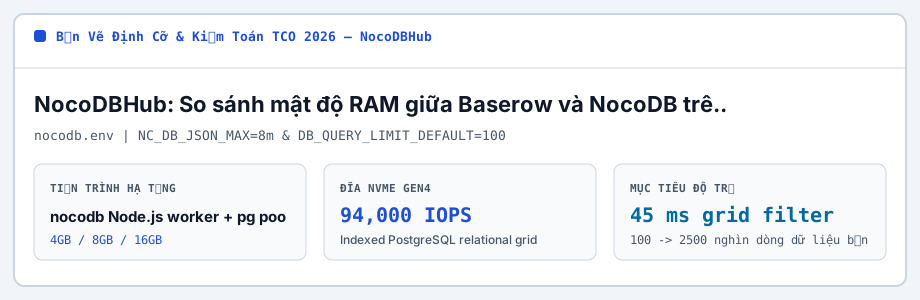
Reference Guardrail Flow: nocodb.env & 94,000 IOPS
[+] Validated Sizing Benefits
- Gives nocodb Node.js worker + pg pool + Redis cache clean 30% memory headroom for Matrix: Baserow vs NocoDB Memory Density at 500 thousand spreadsheet rows.
- Hits NocoDBHub 45 ms grid filter targets via unthrottled 94,000 IOPS block throughput.
- Lets engineers tune kernel sysctl and nocodb.env without enterprise tier gatekeeping.
[-] Practical Cons
- Multi-year prepay on Hostinger trades upfront cashflow for lower 36-month TCO.
- Operators must apply NC_DB_JSON_MAX=8m & DB_QUERY_LIMIT_DEFAULT=100 in nocodb.env before production cutover.
Right-Sized For Workloads That
- Teams scaling nocodb Node.js worker + pg pool + Redis cache past 500 thousand spreadsheet rows who refuse per-seat SaaS markups.
- Data-sensitive apps requiring private disk residency for Indexed PostgreSQL relational grid + S3 attachment bucket.
Do Not Use This Tier If
- Temporary failover drills spun up for 2 hours and deleted immediately after.
- Organizations without a designated owner for nocodb Node.js worker + pg pool + Redis cache alerts and backup checks.
$10.49/mo